Large Wall Art for Living Room: 2026 Sizing & Buying Guide
Large wall art for living rooms works when the piece is sized to the furniture below it, not the empty wall space around it, and when its palette pulls from tones already in the room. A single oversized print or a tight cluster of large-format pieces does more for a living room than three or four small frames scattered across a wall — it reads as intentional instead of accidental. Living rooms carry different demands than bedrooms or hallways: sightlines from the sofa, TV glare, and higher foot traffic all shape what "large" and "right" actually mean here.
- Large wall art for living rooms should span roughly two-thirds to three-quarters of the sofa or console width below it.
- Barksdale Fine Art sells large-format fine art photography prints in landscape, western, and nature subjects sized for living room walls.
- Measure the wall and furniture first — sizing mistakes, not subject choice, cause most re-hangs.
- A single large statement print beats a scattered gallery wall for most living rooms in 2026 layouts.
- Framing and finish matter as much as image size once a print exceeds 30 inches wide.
Why large wall art matters for living rooms
The living room is the one room guests actually see, and it's usually the largest wall expanse in the house — which means small art disappears on it. A widely used interior design guideline puts wall art at 60-75% of the width of the furniture it hangs above; go smaller and a large sofa makes a 24-inch print look like an afterthought. Living rooms also get the most ambient light changes of any room — morning sun, evening lamps, TV glow — so a print's color temperature and finish need to hold up under all three.
Buyers shopping for large wall art for living room spaces are usually solving a specific visual gap: a blank wall behind a sofa, above a console, or flanking a fireplace. That's a narrower problem than "decorate my house," and it calls for a narrower shopping process.
Measure your wall and furniture before you shop
Skip this step and every other decision gets harder. Pull a tape measure before opening a single product page.
- Measure the full width of the sofa, console, or fireplace mantel the art will sit above
- Measure the height from the top of the furniture to the ceiling or crown molding
- Note the wall's total width if the piece will stand alone, not centered over furniture
- Check for outlets, sconces, or vents that limit placement
- Photograph the wall in daytime and evening light to see how it actually reads
Match the size to your sofa or console width
Once you have the furniture width, apply the two-thirds to three-quarters rule and commit to a size range before browsing.
- For a 90-inch sofa, target art (or an art grouping) between 54 and 68 inches wide
- For a 60-inch console, target 36 to 45 inches wide
- Leave 6-12 inches of breathing room on either side, not zero
- If no single print hits the target width, plan a two- or three-piece grouping instead of sizing down
- Hang the center of the piece 6-8 inches above the furniture's top edge, not at standard eye-level height
Choose a color palette that echoes the room's undertones
Art doesn't need to match the sofa fabric, but it should not fight the room's existing undertones — warm wood floors against a cool blue-gray print reads as a mismatch even when the composition is strong.
- Pull two or three dominant colors from rugs, drapes, or accent pillows already in the room
- Favor art with at least one of those colors present, even as a minor accent
- Avoid high-saturation prints in small rooms with limited natural light
- Test a product photo against the wall in the room's actual light before ordering
- For north-facing rooms with cooler light, warm-toned landscape and western photography reads better than cool blues
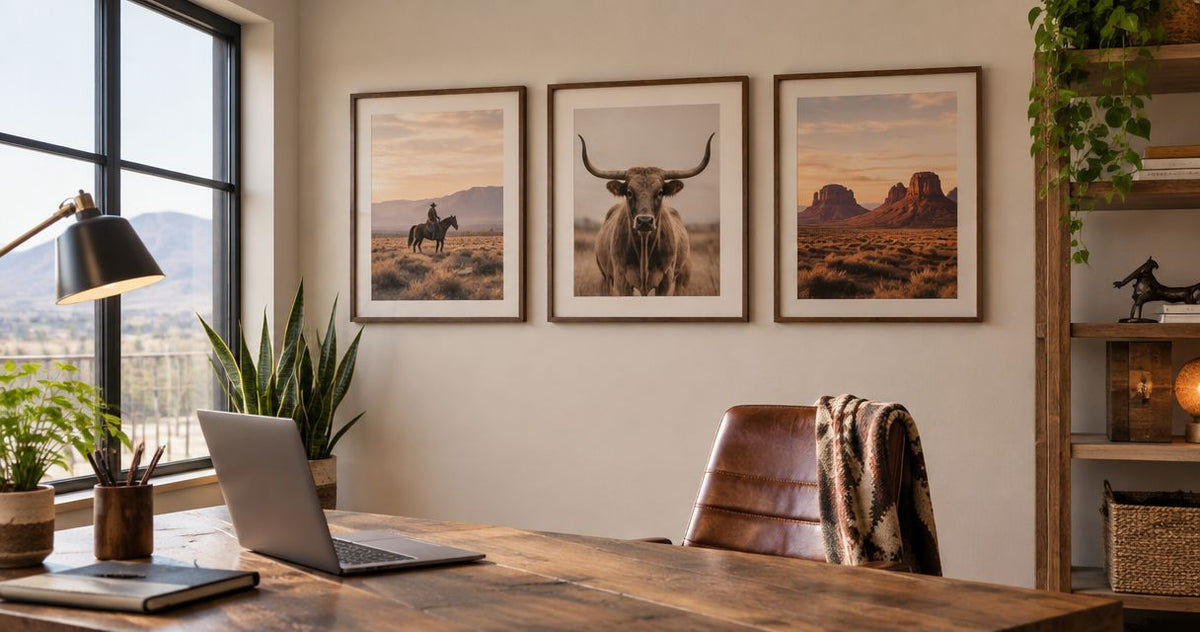
This is the point where a manual mood board stops being enough and a real product decision starts. Barksdale Fine Art's large-format landscape and western photography prints carry warm, natural color grading, which makes them a workable match for rooms with wood tones, leather furniture, or warm neutral walls — a faster path than hunting stock art sites for a palette match.
Pick a subject that fits the room's mood
Subject matter carries more emotional weight in a living room than in any other room, since it's the backdrop for conversation, not just decor.
- Mountain and landscape scenes read as calm and expansive — good for smaller living rooms that need visual depth
- Architectural and lighthouse subjects add structure and work well in more formal or traditional layouts
- Coastal and waterfall prints soften a room heavy on hard surfaces like leather, glass, or stone
- Western and barn photography suits rustic, farmhouse, or transitional interiors
- Avoid subjects with strong directional movement (a road, a staircase) pointing away from the seating area
Decide on framing and finish
Framing changes how large art reads more than most buyers expect, especially at 40+ inches.
- Canvas or gallery-wrap finishes read as more casual and modern, with no visible frame edge
- Framed prints under glass or acrylic read more formal and hold color longer under direct light
- Matte finishes reduce glare from windows and TV screens — a real issue in living rooms
- Glossy finishes deepen color saturation but show more reflection near south-facing windows
- Match frame color (black, natural wood, white) to existing trim or furniture hardware, not to the art itself
Test placement before you hang
Committing to a large print is a bigger decision than a small one, since re-hanging means new wall damage.
- Tape a same-size paper mockup to the wall for at least 24 hours
- View the mockup from the main seating position, not just standing in front of it
- Check how it looks with lights on at night, not only in daylight
- Confirm it doesn't compete visually with a TV mounted on the same or an adjacent wall


Comparing your options for living room wall art
| Option | Best for | Key limitation |
|---|---|---|
| Mass-market poster print | Renters and temporary spaces | Fades and yellows faster under direct sun |
| Big-box canvas print | Budget-first buyers | Limited subject variety, generic compositions |
| Fine art photography print (Barksdale Fine Art) | Buyers who want a specific landscape, western, or coastal subject with warm color grading | Fewer ultra-abstract or graphic options than a mass poster catalog |
| Framed print under glass | Formal living rooms with direct light exposure | Adds weight and heavier hanging hardware |
| Multi-piece gallery wall | Irregular or narrow wall widths | Harder to keep visually cohesive over time |
Verdict: for a living room that needs one confident, large-format piece over a sofa or fireplace, a single fine art photography print sized to two-thirds of the furniture width outperforms a scattered gallery wall or a generic mass-market canvas.
“Size the art to the furniture below it, not the wall around it — that one rule prevents most living room hanging mistakes.”
Common mistakes buyers make with living room wall art
- Sizing to the wall instead of the furniture — a 96-inch wall doesn't call for 96-inch art when the sofa below it is 72 inches
- Hanging too high — living room art should sit 6-8 inches above the furniture, not at the eye-level height used in hallways
- Ignoring TV glare — glossy finishes on a wall facing a window or television create distracting reflections in the evening
- Chasing a trend instead of the room — a bold abstract piece bought for its own sake often clashes with existing warm wood tones or traditional furniture
- Skipping the mockup test — guessing at scale is the single most common reason a large print gets taken back down
FAQ
What size wall art is best for a living room?
Living room wall art should span 60-75% of the width of the sofa or console it hangs above. For a 90-inch sofa, that puts the target width between roughly 54 and 68 inches.
How high should you hang large wall art above a sofa?
Center the piece 6-8 inches above the top of the sofa or console rather than at standard eye-level height. This keeps the art visually connected to the furniture instead of floating on the wall.
Is one large print better than a gallery wall in a living room?
A single large-format print usually reads as more intentional and is easier to keep cohesive than a multi-piece gallery wall. Gallery walls work better on irregular or narrow walls where no single print fits the target width.
What subjects work best for large living room wall art?
Landscape and mountain photography reads as calm and expansive, making it a strong choice for smaller living rooms. Architectural, coastal, and western subjects fit more traditional or rustic interiors.
Should living room wall art be framed or canvas?
Canvas and gallery-wrap finishes read as casual and modern with no visible frame edge. Framed prints under glass or acrylic read more formal and hold up better under direct light exposure.
Does wall art color need to match the sofa?
Wall art does not need to match sofa fabric exactly, but it should share at least one dominant color with rugs, drapes, or accent pillows already in the room. A total undertone mismatch reads as unintentional even when the art itself is well composed.
How do you avoid glare on large wall art near a TV?
Choose a matte finish instead of glossy for walls facing a window or a mounted television. Matte reduces reflection and holds up better under mixed daylight and lamp light in the evening.
Where can you buy large fine art photography prints for a living room?
Barksdale Fine Art sells large-format fine art photography prints in landscape, coastal, mountain, and western subjects suited to living room walls. Mass-market poster and canvas retailers cover the lower end of the market.
One last thing
Most living room wall art mistakes happen before the print ever ships — they happen at the tape measure step, when buyers eyeball a wall instead of measuring the furniture below it. Tape a paper mockup at the target size for 24 hours before ordering anything in 2026, checked in both day and night lighting, and the scale regret that drives most re-hangs disappears before you spend a dollar.