Best wildlife wall art for nurseries and kids rooms in 2026
Best overall: single-animal photography; best for woodland nurseries: woodland animal illustration; best for a simple graphic scheme: animal silhouettes. This 2026 guide compares wildlife wall art for nurseries and kids rooms, including Barksdale Fine Art nature prints as habitat companions rather than animal portraits.
- Single-animal photography is the default choice for wildlife wall art for nurseries and kids rooms.
- Woodland animal illustration suits storybook nurseries; safari illustration suits coordinated animal-themed rooms.
- Barksdale Fine Art nature prints work best as habitat companions, not substitutes for wildlife portraits.
- Choose the subject first, then check composition, wall placement, and mounting requirements.
Why this matters
An animal theme does not require animals on every surface. Your wall art can carry the theme while bedding, storage, and furniture stay visually simple.
The useful distinction is between wildlife artwork, which depicts wild animals, and habitat artwork, which depicts their surroundings. A forest stream supports a woodland room, but it does not replace the fox, deer, or owl your child wants to see. Likewise, cattle belong to a farm or western theme, not a wildlife shortlist.
For a room you are decorating in 2026, start with the image rather than the theme label. Look at the animal's expression, the surrounding detail, and how the artwork relates to the room's main viewing position. Those decisions are more useful than choosing a print because its listing says “nursery.”
What makes the best wildlife wall art
Use these criteria to choose between the options below. They explain the recommendations without pretending that every room needs the same artwork.
- Subject clarity: You should be able to identify the animal from the room's normal viewing position. Background detail should support the subject rather than hide it.
- Expression and action: Choose a pose you want to see every day. A resting animal and a hunting scene serve different decorating intentions.
- Palette fit: Repeat colors already present in the room instead of introducing an unrelated scheme just for the artwork.
- Composition: Decide whether you want a distinct animal portrait, a group of characters, or a landscape with room around the subject.
- Growing-room fit: Choose between a deliberately storybook look and artwork you would also display outside a nursery.
- Practical placement: Check the finished dimensions, frame or display requirements, and mounting instructions before choosing the wall.
For an initial layout, plan 1 focal print, repeat 2 accent colors, and compare 3 paper templates on the wall. These are starting choices for your mock-up, not rules about a child's development or a print's performance.
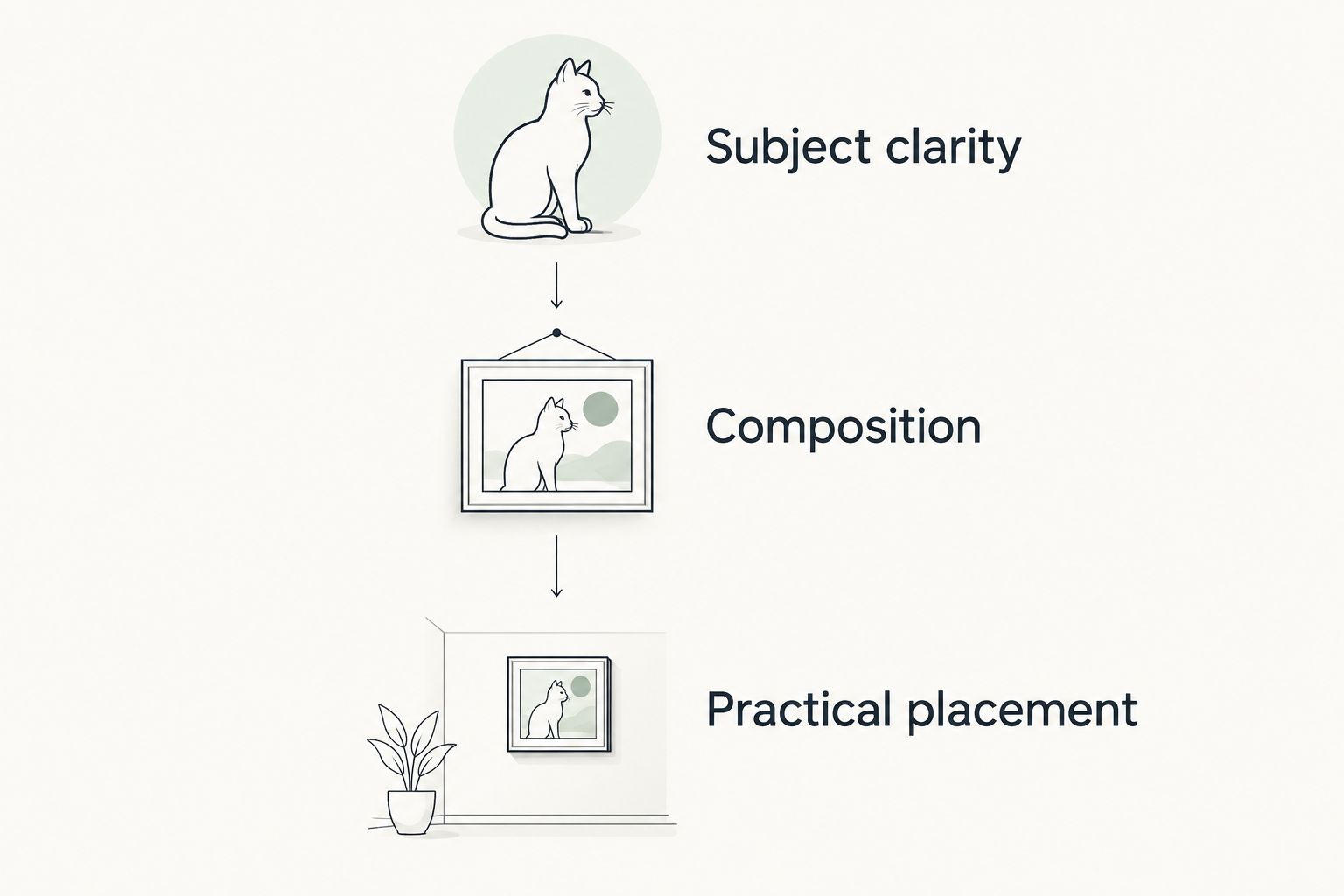
The decision sequence is simple: subject first, composition next, placement last. Do not let an attractive frame decide the animal or scene for you.
Wildlife wall art at a glance
These are artwork types, not claims that particular products have been tested. Each option has a different use-case slot, so the table works as a decision guide rather than a universal leaderboard.
| Rank and option | Best for | Standout feature | Key limitation |
|---|---|---|---|
| 1. Single-animal photography | A recognizable animal focal point | A real animal rather than an invented character | Expressions and backgrounds need careful selection |
| 2. Woodland animal illustration | Storybook nurseries | Illustrated forest characters | A deliberately juvenile style is less transferable |
| 3. Safari animal illustration | Coordinated multi-animal rooms | A shared visual treatment across different animals | A collection can crowd the wall |
| 4. Ocean wildlife illustration | Marine-themed kids rooms | Underwater animals and scenes | Small subjects can disappear in a busy composition |
| 5. Animal silhouettes | Simple graphic decorating schemes | Clear outlines and restrained detail | Limited facial and anatomical detail |
| 6. Habitat photography, including Mountain Stream Photography | A supporting woodland backdrop | Forest scenery rather than an animal portrait | Does not satisfy an animal-specific brief by itself |
1. Single-animal photography: best wildlife wall art for a focal point
Single-animal photography puts a real animal at the center of the artwork. Choose a photograph in which the animal remains distinct from the background, whether the subject is a deer, elephant, bird, or another favorite species.
This is the strongest default when your child has a specific animal in mind. For a 2026 room refresh, choose the photograph for its subject and composition, not simply because its colors match the curtains.
Single-animal photography pros:
- Shows a real animal rather than a stylized character.
- Makes an animal-specific decorating brief straightforward.
- Can work as a standalone focal image without a matching set.
Single-animal photography cons:
- A dramatic expression or predatory scene might conflict with your intended room mood.
- Dense foliage or distant subjects can make the animal harder to see.
Best for: A nursery or kids room built around one recognizable wild animal.
Look at the full image, not only a cropped listing thumbnail. Check whether the face, body, and surroundings still make sense together, then view the composition from the doorway.
Verdict: Buy single-animal photography when the animal itself is the priority.
2. Woodland animal illustration: best wildlife wall art for storybook nurseries
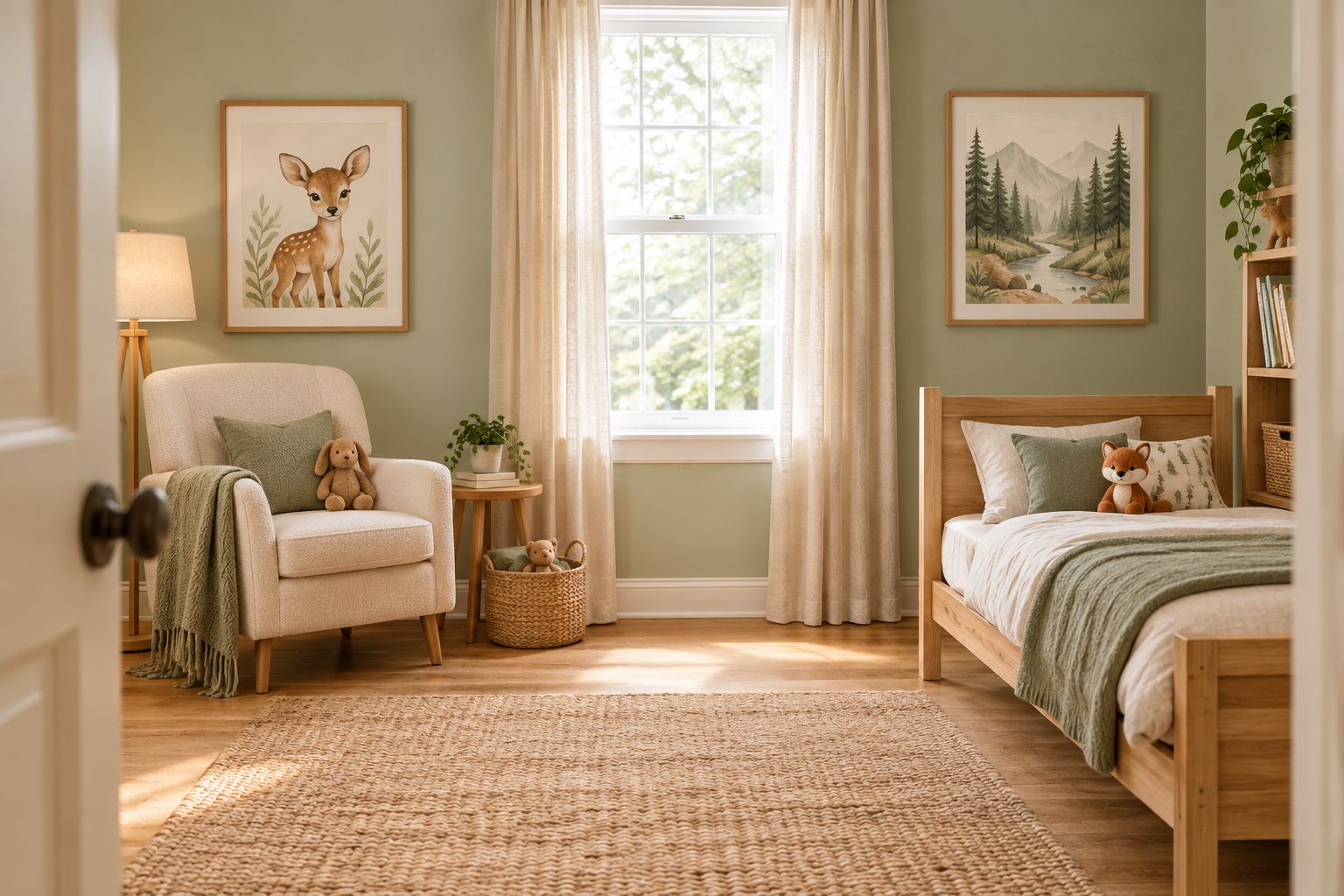
Woodland animal illustration presents forest animals through drawing or digital illustration. Foxes, deer, owls, and other woodland subjects can appear as individual portraits or as characters within a scene.
Choose this approach because you want an illustrated nursery, not because you expect it to teach realistic animal anatomy. The artist's treatment determines whether the artwork feels playful, decorative, or closer to a natural-history illustration.
Woodland animal illustration pros:
- Gives you an explicitly illustrated, storybook direction.
- Works with forest motifs such as leaves, branches, and trees.
- Lets you choose between individual characters and narrative scenes.
Woodland animal illustration cons:
- Clothing and exaggerated expressions make the animals less realistic.
- A strongly baby-themed treatment can limit where you reuse the artwork.
Best for: A nursery with an intentional storybook or woodland-character theme.
Keep other animal motifs selective. If the artwork already contains several characters, plain bedding gives those characters room to be the main visual feature.
Verdict: Buy woodland animal illustration for a deliberately storybook room.
3. Safari animal illustration: best wildlife wall art for coordinated sets
Safari animal illustration groups subjects such as elephants, giraffes, zebras, and lions through a common artistic style. The coordination comes from the artwork's palette, line treatment, and composition—not from buying every animal available.
Start with the animals your child actually likes. A coordinated set is useful when the room calls for several pictures, but an unrelated extra print does not improve the arrangement simply by completing a collection.
Safari animal illustration pros:
- Provides a clear direction for a multi-animal theme.
- Allows different species to share a consistent visual treatment.
- Offers a choice between separate portraits and a combined scene.
Safari animal illustration cons:
- Too many separate pictures can compete with shelves and other decorations.
- Stylized scenes are not substitutes for accurate habitat references.
Best for: A coordinated animal-themed room with a planned picture grouping.
In 2026, choose the grouping around your wall rather than a preselected room package. Lay out the images together before mounting, and remove any picture that repeats the same role without adding a subject your child wants.
Verdict: Buy safari animal illustration when coordination matters more than photographic realism.
4. Ocean wildlife illustration: best wildlife wall art for marine themes
Ocean wildlife illustration focuses on marine animals such as whales, dolphins, sea turtles, and fish. It can depict an individual creature or an underwater scene containing several subjects.
Decide which of those jobs you need. A whale portrait makes the animal the focal point; an underwater scene makes the surrounding environment part of the artwork.
Ocean wildlife illustration pros:
- Gives a marine-themed room actual animal subjects.
- Supports either a single-creature portrait or an underwater composition.
- Offers an alternative to land-animal decorating themes.
Ocean wildlife illustration cons:
- Small animals can become secondary to bubbles, plants, and other details.
- A seascape without animals is coastal artwork, not ocean wildlife artwork.
Best for: A kids room centered on marine animals rather than beach scenery.
Check the subject at the intended viewing distance. If identifying the sea turtle requires standing close to the picture, choose a clearer composition for a wall you mainly see from across the room.
Verdict: Buy ocean wildlife illustration when marine animals are the room's main subject.
5. Animal silhouettes: best wildlife wall art for simple graphic rooms
Animal silhouettes describe animals mainly through outlines rather than facial features or detailed textures. They suit a decorating brief that prioritizes shape and a restrained palette.
Choose a species with an outline your child recognizes. A silhouette does a different job from a portrait: it contributes an animal shape without making expression or surface detail central to the artwork.
Animal silhouette pros:
- Provides a clearly graphic alternative to photographs and painted scenes.
- Keeps background and surface detail limited.
- Fits a brief built around outlines and contrasting shapes.
Animal silhouette cons:
- Similar animal outlines can be difficult to distinguish.
- Omits the expression and anatomical detail that some children want.
Best for: A simple graphic room where animal shapes matter more than detailed portraits.
Ask your child to identify the subject before making the final selection. If the appeal depends on reading the product title, a more descriptive image is the better match.
Verdict: Buy animal silhouettes for visual simplicity; skip them when detail is the priority.
6. Habitat photography: best nature wall art for woodland backdrops
Habitat photography shows the setting rather than making an animal the subject. Forests, streams, mountains, and wetlands belong in this category when the landscape carries the composition.
Barksdale Fine Art nature prints are best for buyers who want a habitat backdrop for an animal-themed room. Mountain Stream Photography is a woodland companion, not a wildlife portrait; that distinction makes its role clear before you decide where to display it.
Habitat photography pros:
- Adds scenery to a room already containing animal artwork.
- Supports a nature theme without repeating animal characters.
- Offers a landscape-focused alternative for a room that is not exclusively nursery-themed.
Habitat photography cons:
- Does not meet a request for a particular animal by itself.
- Can distract from the main portrait if both compositions demand attention.
Best for: A supporting nature image beside an animal-focused decorating scheme.
Choose Barksdale Fine Art habitat photography for the setting, then keep your wildlife focal image distinct. Do not label a forest print as animal art simply because both belong in a woodland room.
Verdict: Buy habitat photography as a companion; skip it as a substitute for an animal portrait.
How to arrange the artwork
Choose a wall outside the crib area and keep framed or heavy artwork away from places where a child sleeps or can pull it down. Follow the artwork's and mounting hardware's instructions rather than assuming every frame uses the same fixing.
Use your paper templates to compare placement before making holes. Check the arrangement from the doorway and from the room's usual sitting position; both views matter.
A useful starting arrangement is an animal focal image on an open wall with supporting scenery elsewhere. Keep the animal image visibly separate from shelving clutter so the subject remains the feature.
How the options are ranked
The 2026 ranking prioritizes a clear animal subject, a distinct decorating use case, and the ability to judge the composition before choosing it. Single-animal photography comes first because it answers an animal-specific brief directly.
Illustrated options follow according to the room theme they serve. Habitat photography sits last because it supports wildlife decorating without necessarily depicting wildlife. This is a selection framework, not a product test or a sales-based ranking.
Which wildlife wall art should you choose?
Choose single-animal photography if you are undecided. It gives you a clear starting point: the animal your child wants, presented as the main subject.
Choose woodland illustration for storybook characters, safari illustration for coordinated animal groupings, ocean illustration for marine subjects, and silhouettes for a graphic scheme. Add Barksdale Fine Art nature prints only when you want scenery alongside the animal artwork.
For your 2026 shortlist, settle the subject before the frame or arrangement. That keeps the decorating decision tied to what you actually want on the wall.
FAQ
What's the best wildlife wall art for nurseries and kids rooms?
Single-animal photography is the default choice when you want a recognizable animal focal point. Choose woodland illustration instead when the room has an intentional storybook theme.
Is animal photography better than illustration for a nursery?
Animal photography is better for a real-animal subject; illustration is better for an intentionally stylized look. Choose according to the room's decorating brief rather than treating either medium as universally better.
Can I use forest landscape prints in an animal-themed room?
Yes, forest landscape prints can support an animal-themed room as habitat artwork. Barksdale Fine Art nature prints serve that supporting role, but a landscape is not a substitute for a requested animal portrait.
What should I choose for a safari-themed kids room?
Choose safari animal illustration when you want different animals presented in a coordinated style. Select the animals your child likes and check the complete wall arrangement before mounting.
Is ocean wall art the same as ocean wildlife wall art?
No, ocean wildlife wall art depicts marine animals, while ocean wall art can show water, beaches, or other coastal subjects. Check that the creature you want is actually present and clearly visible.
Should I hang framed wildlife artwork above a crib?
Keep framed or heavy artwork away from the crib and other places where a child sleeps or can pull it down. Choose a separate display wall and follow the mounting instructions for the artwork and hardware.
How do I choose artwork that still fits when the room changes?
Choose the subject and artistic treatment rather than relying on nursery wording. A realistic animal portrait or landscape offers a different reuse option from artwork built around baby-specific characters or text.
One last thing
The animal does not have to match every other animal in the room. Ask your child which creature deserves the main wall, then use the rest of the decor to support that choice.
A favorite subject is a stronger reason to choose a print than completing a theme. Keep the animal your child wants; remove the decorative extras you do not need.