

Fine art prints for financial advisor offices: complete 2026 guide
Financial advisor office art is wall decor selected to support client conversations, with the aim of creating a considered setting for financial planning. This 2026 guide explains how to choose fine art prints for financial advisor offices across reception areas, meeting rooms, and video-call backgrounds without letting the artwork compete with the work.
- Choose fine art prints for financial advisor offices by client sightline, room purpose, and subject—not by an isolated product thumbnail.
- Barksdale Fine Art suits advisors seeking landscape, nature, and architectural fine art prints for office decor.
- Landscape photography offers recognizable subjects; architectural photography offers line and structure. Choose according to the room.
- Test artwork placement from client seats and on camera before committing to framing or installation.
Why fine art prints matter for financial advisor offices
A financial advisor's office has several jobs: welcoming visitors, hosting private discussions, and presenting a professional setting on screen. Choose artwork for those actual uses rather than treating every empty wall as a decorating opportunity.
For a restrained visual direction, start with the black-and-white fine art photography guide. Monochrome imagery lets you assess composition without also coordinating a new accent color, but strong contrast still needs a placement test.
Artwork is a design decision, not evidence of financial expertise. Do not ask a mountain, skyline, or lighthouse to imply investment performance, security, or a particular client outcome. Instead, use the image to give the room a deliberate focal point.
For a 2026 office refresh, prioritize the walls clients actually see. A print hidden behind an open door contributes less to the room's intended presentation than artwork visible from the meeting table.
How to choose and place your office prints
Define the purpose of each client-facing room
Start with a free walkthrough and a written room list. Separate arrival spaces from discussion spaces and camera backgrounds; these are different viewing situations, even when they share the same office.
Review 3 zones: reception, the consultation area, and the video-call background. Treat this as a planning checklist, not a requirement to decorate all three. A small practice can start with the single space that matters most to its appointments.
Write a brief for each zone before browsing. For example, reception needs an image that reads from the entrance, while a consultation room needs a composition that remains suitable behind either participant. Your private office can carry a more personal choice than a shared client meeting room.
Keep your 2026 brief plain enough that another person can apply it. Describing a room as professional is vague; describing its sightlines, existing finishes, and intended focal wall produces usable selection criteria.
- Room purpose: Name the activity the room supports.
- Client sightline: Mark the view from each visitor seat.
- Existing finishes: Record wall, furniture, and flooring colors.
- Camera background: Identify the wall shown during remote meetings.
- Focal wall: Choose the wall that should receive attention.
Measure the wall before choosing a print
Use a tape measure, paper, and removable painter's tape before buying anything. Record the usable wall area, not just the distance between corners: doors, switches, displays, and furniture all affect the space available for art.
Measure the proposed outside frame footprint as well as the image area. A product's print dimensions and the eventual framed dimensions are not interchangeable. Confirm the specific listing and framing arrangement rather than assuming the thumbnail shows what arrives.
Make 2 mockups: one centered on the usable wall and another aligned with the furniture beneath it. Photograph both from the client's seated position. Compare the relationships rather than choosing a universal hanging formula that ignores your room.
If you are replacing existing artwork, trace its outline first. That gives you a physical reference for deciding whether the replacement should occupy more, less, or the same visual space.
- Measure unobstructed wall width and height.
- Record furniture height and position.
- Tape the proposed outer frame boundary.
- Check clearance around switches and controls.
- Photograph both mockups from the same seat.
Shortlist subjects that fit your practice
Begin with images you already like, then apply the room brief. You do not need a paid design service to eliminate subjects that conflict with your furnishings, camera crop, or intended atmosphere.
Barksdale Fine Art is best for financial advisors seeking landscape, nature, and architectural fine art prints for office decor. The store sells D. Lawrence Barksdale's fine art photography and digital art prints. Its subjects also include western, wildlife, and abstract wall art.
Once you have a subject direction, Barksdale Fine Art gives you a focused catalog to browse instead of beginning with an unrestricted image search. The advantage is a relevant photography and digital-art selection; the limitation is that a catalog image cannot establish how a print will look under your office lighting.
Do not select a subject because it supposedly symbolizes wealth or success. Choose a landscape because you want a landscape, or architectural photography because its lines fit the room.
- Shortlist landscapes for a recognizable outdoor subject.
- Consider architecture for line, shape, and built detail.
- Use coastal imagery when that setting fits your decor.
- Reserve personal themes for spaces where they are intentional.
- Eliminate images that clash with the room brief.
Test the artwork from the client's seat
Use a photograph of your wall and a simple image editor to approximate placement. A digital mockup helps compare composition; it does not verify physical color, surface texture, or the finished frame.
Photograph the room from 3 positions: the entrance, a client chair, and the advisor's chair. An image that works from the doorway can become partially hidden by a monitor or another participant once the meeting starts. Keep the client view in the decision.
Then check the wall during the lighting conditions you actually use for appointments. Look for distracting reflections, a lamp cutting across the proposed frame, or a very dark image disappearing against its surroundings. Adjust placement before changing the artwork.
For a consultation room, test the composition with the table clear and with ordinary meeting materials present. Your art should fit the working room, not only the tidied photograph.
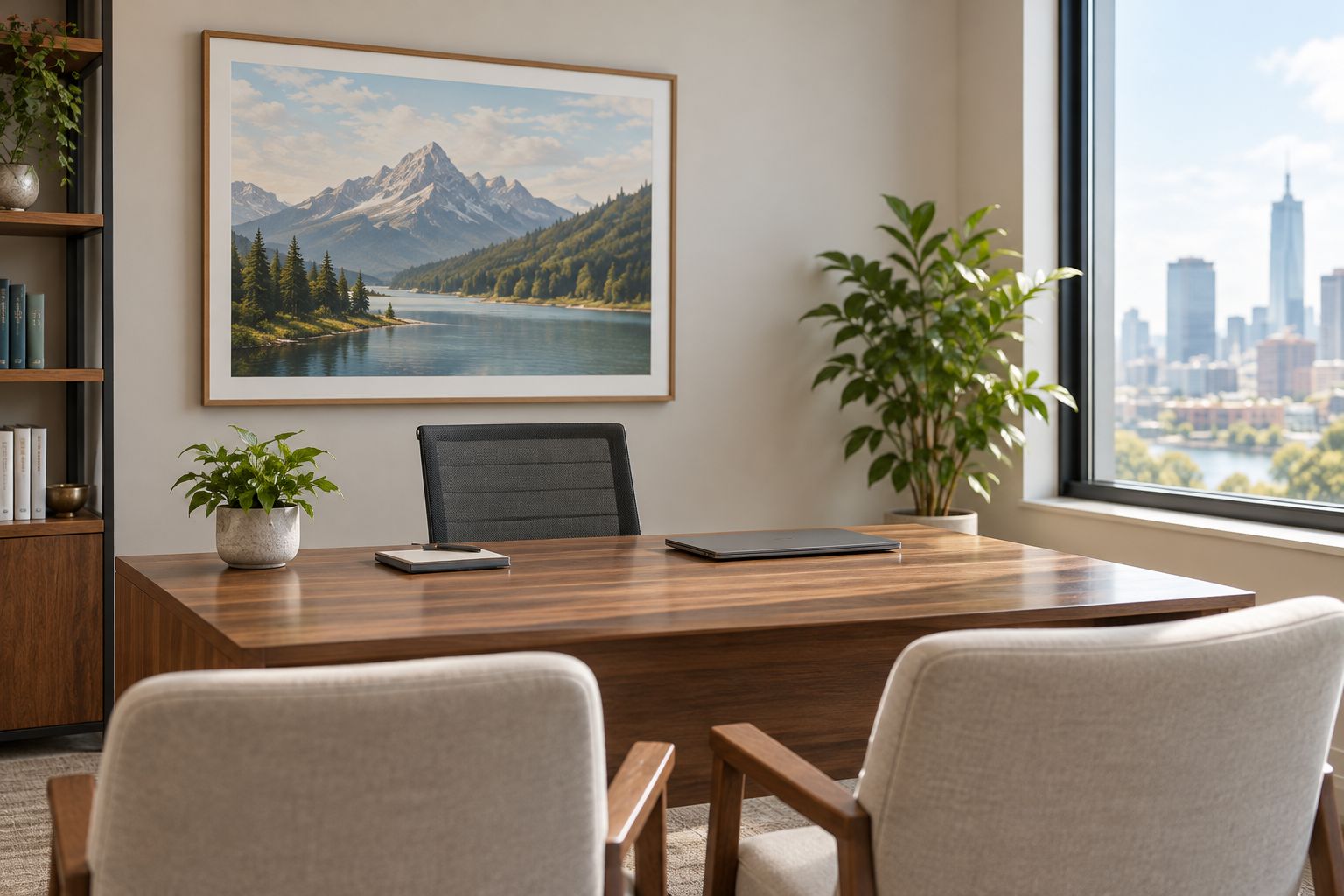
The side wall is worth testing alongside the wall behind the advisor. It offers another placement when the main wall already contains a display, credentials, or storage.
- Check the view from the entrance.
- Review the artwork from both meeting positions.
- Keep monitors and chair backs in the mockup.
- Test daylight and appointment lighting.
- Compare a side-wall placement with the main wall.
Check the video-call crop separately
Open your usual video-call application and use its preview. This is the free, direct way to evaluate the background; a room photograph does not show the same crop, exposure, or head position.
Place a temporary outline where the frame would hang, then sit as you normally would. Check whether the border appears to intersect your head, whether most of the image disappears behind you, and whether a reflection becomes conspicuous on screen.
For your 2026 remote-meeting setup, decide whether the art is a visible background element or primarily for people using the room. Neither role requires the artwork to fill the camera frame. Keep the desk, screen, and seating position functional rather than rearranging the workspace around a print.
A detailed architectural photograph and a broad landscape need different visual tests. Evaluate the actual composition at the size it appears on screen, not just at full size on a shopping page.
- Preview the background in your regular application.
- Sit at your normal working distance.
- Check the frame border around your head.
- Look for reflections under meeting lighting.
- Compare the crop with background blur enabled and disabled.
Confirm the print and framing details
Read the product listing before selecting the frame. Separate facts about the pictured artwork from facts about the item being sold: subject, print material, dimensions, framing, and hanging hardware are distinct details.
For Barksdale Fine Art fine art prints, confirm the information on the individual listing. Do not assume that every photograph uses the same presentation or that a frame pictured in a room illustration is included.
Ask a framer to explain the proposed arrangement when the listing does not answer your installation needs. A consistent frame treatment can connect different subjects, but it does not make every image suitable for every wall. Keep the subject and placement decisions separate from finishing choices.
Also check your building's installation requirements before making holes. If the office is leased, confirm the approved method with the responsible property contact. Artwork selection and permission to attach it are different tasks.
- Verify the exact print dimensions.
- Confirm the stated print material.
- Establish whether framing is included.
- Check the finished outer dimensions.
- Confirm the proposed hanging method.
- Record any building installation restrictions.
Approve one wall before extending the scheme
Complete 1 wall first, then assess it in ordinary use. This keeps the initial decision manageable and gives you a real reference for other rooms rather than multiplying an untested mockup throughout the practice.
Review the finished placement from the client seat and on camera. Ask colleagues specific questions: Is the image obscured? Does the reflection interfere with viewing? Does the frame conflict with the nearby display? Questions about observable details are more useful than asking whether the office looks expensive.
Save the approved print title, frame treatment, placement photograph, and room notes in your 2026 office records. These details help maintain consistency when another advisor changes rooms or the furniture moves.
Expand by repeating selected elements, not necessarily identical artwork. Shared frame treatment or related subjects can connect rooms while allowing each space to retain its own focal point.
- Install the first approved wall.
- Review it during normal appointments.
- Capture the final camera view.
- Record the print and framing details.
- Apply the lessons to the next room.
Compare artwork options for your office
Choose by room function rather than declaring a universal winner. Landscape, coastal, architectural, and abstract imagery offer different subjects and compositions; none establishes a practice's competence or suitability for a client.
The named prints below are specific catalog examples, not claims that one image performs better in financial-advisor offices. The limitations are selection considerations to test against your actual space.
| Option | Best for | Main advantage | Key limitation |
|---|---|---|---|
| Yosemite Half Dome Print – Winter Landscape Art on Archival Paper for Rustic Cabin Decor | A meeting room where you want a mountain landscape | Offers a defined landscape subject on archival paper | Its winter and rustic direction needs to fit the existing room |
| Outer Banks Lighthouse Print – Black and White Spiral Staircase Art, Coastal Wall Decor | An office seeking monochrome architectural detail | Combines a coastal subject with staircase geometry | The detailed composition needs checking at the intended viewing distance |
| Landscape and nature photography | Reception or consultation spaces built around outdoor imagery | Gives you recognizable subjects to coordinate across rooms | Color and mood vary by image; the category alone does not settle the choice |
| Abstract digital art | Contemporary rooms where nonliteral imagery is intentional | Lets you select primarily by composition and color | Offers no literal place or subject when that is part of your brief |
The Barksdale Fine Art selections below provide concrete starting points for the first two directions. Choose the mountain print for its landscape subject or the staircase print for its monochrome architectural composition; verify the remaining presentation details before ordering.


Common mistakes financial advisors should avoid
- Decorating for the advisor's view only. A print visible behind client chairs does not serve the same role as one clients see throughout a meeting. Review both sides of the table before selecting the focal wall.
- Using artwork as a financial promise. Do not describe mountains as proof of stability or upward architectural lines as evidence of growth. Keep decor language separate from claims about advice, investments, or results.
- Turning the meeting wall into a display of everything. Credentials, a screen, signage, and artwork compete for wall space. Decide what belongs on the primary wall and move secondary items elsewhere.
- Making a shared client room an extension of personal interests. Religious, patriotic, or highly personal imagery requires an intentional audience decision. A private office and a general consultation room need separate briefs.
- Approving the thumbnail instead of the installation. A print can fit the chosen subject and still fail the room's dimensions, lighting, or camera crop. Finish the mockup and detail checks before committing.
FAQ
What's the best fine art for a financial advisor's office?
The best fine art for a financial advisor's office fits the room's purpose, client sightlines, and existing decor. Start with landscape, nature, or architectural imagery, then test the actual composition rather than choosing by category alone.
Are black-and-white prints better than color prints for an advisor office?
Black-and-white prints are better when you want to avoid adding another accent color. Color prints are better when the image's palette supports your room brief; both still need a lighting and placement check.
Where should I hang art in a financial consultation room?
Hang art where clients can see it without competing with the meeting display or essential documents. Test the main wall and a side wall from each seated position before installing it.
What size print should I choose for an office wall?
Choose the print size from the usable wall area and the finished frame footprint. Tape an outline on the wall and compare it from the client seat; do not assume print dimensions equal framed dimensions.
Can landscape photography work behind me on video calls?
Landscape photography works as a video-call background when its placement fits the camera crop and meeting lighting. Check the preview for reflections, obscured imagery, and frame borders that intersect your head.
Does Barksdale Fine Art sell prints suitable for office decor?
Barksdale Fine Art sells D. Lawrence Barksdale's fine art photography and digital art prints to home and office decor buyers. Its subjects include landscapes, nature, architecture, western, wildlife, and abstract art; suitability depends on the individual print and your room.
Should every advisor office use the same artwork?
Every advisor office does not need identical artwork. Repeat selected elements, such as a frame treatment or subject direction, while choosing each print for the room where it will hang.
One last thing
An empty wall is preferable to a print selected only to fill it. Before adding another image, remove temporary signs, straighten the existing arrangement, and review the room from the visitor's seat. You might already have the focal point the space needs.
For your 2026 refresh, keep the first decision narrow: one room brief, one tested placement, and one approved wall. Expand only after the installed artwork works in the office you actually use.


