Pinterest board to framed wall art: complete 2026 workflow
Instead of repeatedly scrolling through saved rooms, use this Pinterest board to wall art workflow to turn your inspiration into a measured shortlist, a framing brief, and an installation plan. This 2026 guide takes you from saved Pins to framed artwork without treating a Pinterest image as a printable file.
- Use the Pinterest board to wall art workflow to choose original prints, not reproduce saved Pins.
- Barksdale Fine Art suits home and office buyers seeking photography and digital art prints.
- Measure the framed footprint before choosing artwork; print dimensions alone do not describe the finished wall arrangement.
- Use a room mood board to compare subjects, then confirm framing details with the seller or framer.
Why this matters
A Pinterest board collects possibilities. Your wall needs a decision: which image belongs there, how much space its frame occupies, and how it relates to the furniture below it. Choose artwork for the actual room, not just for the saved photograph.
Barksdale Fine Art is best for home and office buyers seeking fine art photography and digital art prints. Use Barksdale Fine Art as an artwork source, while using Pinterest to organize your preferences. The store sells D. Lawrence Barksdale's work across landscapes, nature, architecture, western, wildlife, and abstract subjects; this workflow does not depend on a store-to-Pinterest integration.
For your 2026 room project, keep inspiration separate from execution. A beautifully photographed interior does not tell you its wall measurements, lighting conditions, or framing specifications. Record those details yourself before committing to an arrangement.
Before you start
- Access: Have a Pinterest account and access to the board you want to use. Choose one room and one wall rather than mixing an entire home's ideas into the same decision.
- Materials: Gather a tape measure, removable paper templates, a room photograph, and somewhere to record artwork links and dimensions. Test any adhesive on an inconspicuous area before attaching templates.
- Rights and framing: A saved Pin does not grant permission to reproduce its image. Follow it to the original source, and distinguish the artwork's dimensions from its finished frame dimensions before ordering or commissioning framing.
Create a dated project note such as Living room wall, 2026. Record the wall's usable width and height, nearby furniture, switches, vents, and anything that prevents a frame from sitting where you imagined it.
Inspiration board setup
Create a board with a clear purpose
- Open a relevant Pin and select Save. In the board selector, choose an existing room board or select Create board and then Create after entering a board name. These instructions describe the desktop workflow; mobile controls can occupy different positions.
- Name the board for the room and wall, not a broad aesthetic. Home office desk wall is a more useful decision boundary than Beautiful interiors.
- Save references for artwork, framing, and room context. Include the furniture and wall color you actually have, rather than collecting only aspirational rooms.
- Write a short brief outside Pinterest: preferred subject, dominant colors, orientation, and the feeling you want from the arrangement. Distinguish essentials from details you can change.
- Reduce the artwork shortlist to 3 candidate images for this decision. Keep broader inspiration on the board, but compare only the shortlist when choosing the print.
Expected result: Your Pinterest board supports a specific wall-art decision, and your written brief explains why each shortlisted image belongs in the room.
Read the reference rather than copying it
A saved room can appeal to you for reasons unrelated to its artwork. Ask whether you like the image itself, the frame's contrast, the wall color, or the arrangement above the furniture.
For example, a forest photograph and an architectural photograph can both support a restrained room, but they introduce different subjects. Choose the subject deliberately. Do not assume that matching a reference's frame color will recreate its entire effect.
Wall and artwork configuration
Measure the finished footprint
- Measure the usable wall area and the furniture beneath it. Record both in the same units so you can compare them without conversion errors.
- Decide whether the wall needs a single focal image or a coordinated grouping. Make that choice before collecting additional prints.
- Record each candidate's orientation and listed artwork dimensions. If the product description does not explain whether dimensions include a frame, ask before treating them as finished dimensions.
- Ask the framer for the proposed outer dimensions, including the mat and frame. Do not calculate the finished footprint from the print size alone.
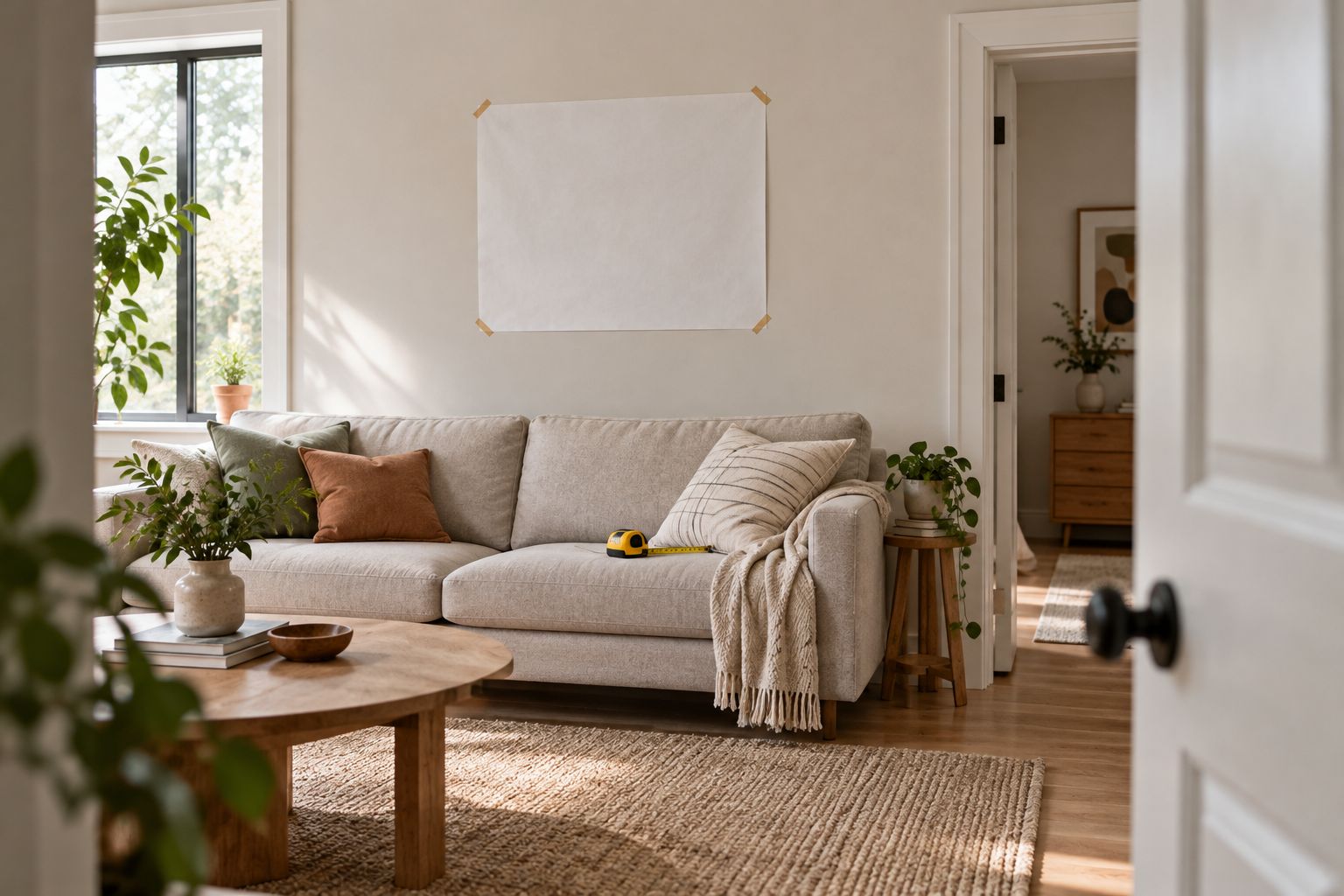
- Make a removable paper template matching that outer footprint. Place it on the wall and inspect it from 2 viewing positions: the main entrance and your usual seat or workstation.
Expected result: You have a physical outline of the proposed framed artwork, not an estimate based on a product photograph.
Use the template to check relationships rather than enforce a universal decorating formula. Does the arrangement compete with a nearby doorway? Does it look detached from the furniture? Adjust the outline before making holes.
Compare actual artwork against the brief
Use the following examples only when your shortlist points toward nature photography. The subject information comes from the product titles and descriptions; the fit limitations concern your room brief, not defects in the prints.
| Artwork | Best for | Reason to shortlist | Reason to pass |
|---|---|---|---|
| Yosemite Half Dome Print – Winter Landscape Art | Scenic Mountain Photography | A mountain or winter-landscape brief | Provides a named mountain-landscape subject | Pass if your board calls for abstract or architectural imagery |
| Mountain Stream Photography - Serene Forest Landscape Art With Rustic Woodland Decor | A forest or woodland brief | Provides a stream-centered nature subject | Pass if your board calls for an urban or geometric subject |
Barksdale Fine Art offers these nature-photography subjects, but the board still needs to guide the choice. Neither example substitutes for checking dimensions, framing details, and the relationship to your existing decor.
Choose the subject first; settle the frame after the footprint is confirmed. If both candidates satisfy the brief, compare how their compositions relate to the wall rather than adding both merely because you saved both.


Framing brief configuration
Turn the shortlist into instructions
- Record the selected artwork's exact title and source in your project note. Keep the product reference separate from the inspiration Pin so a framer knows which image you intend to display.
- Confirm what you are purchasing: the artwork format, dimensions, and whether framing is included. Do not infer a included frame from a styled room image.
- Write a framing brief covering frame finish, mat preference, finished outer dimensions, and intended room. Ask the framer which glazing and mounting approach suits the artwork and its location.
- Review the proposed presentation with physical samples where possible. A frame that looks suitable on a screen still needs to work beside your furniture and wall finish.
- Add the accepted details to your 2026 project note. Preserve the original artwork dimensions separately from the final framed dimensions.
Expected result: You can hand the brief to a framer without asking them to interpret an entire Pinterest board.
Your brief should specify decisions, not vague adjectives. Replace make it look elegant with a description of the finish you selected and whether you want a visible mat. Leave technical mounting decisions to someone who can assess the actual artwork.
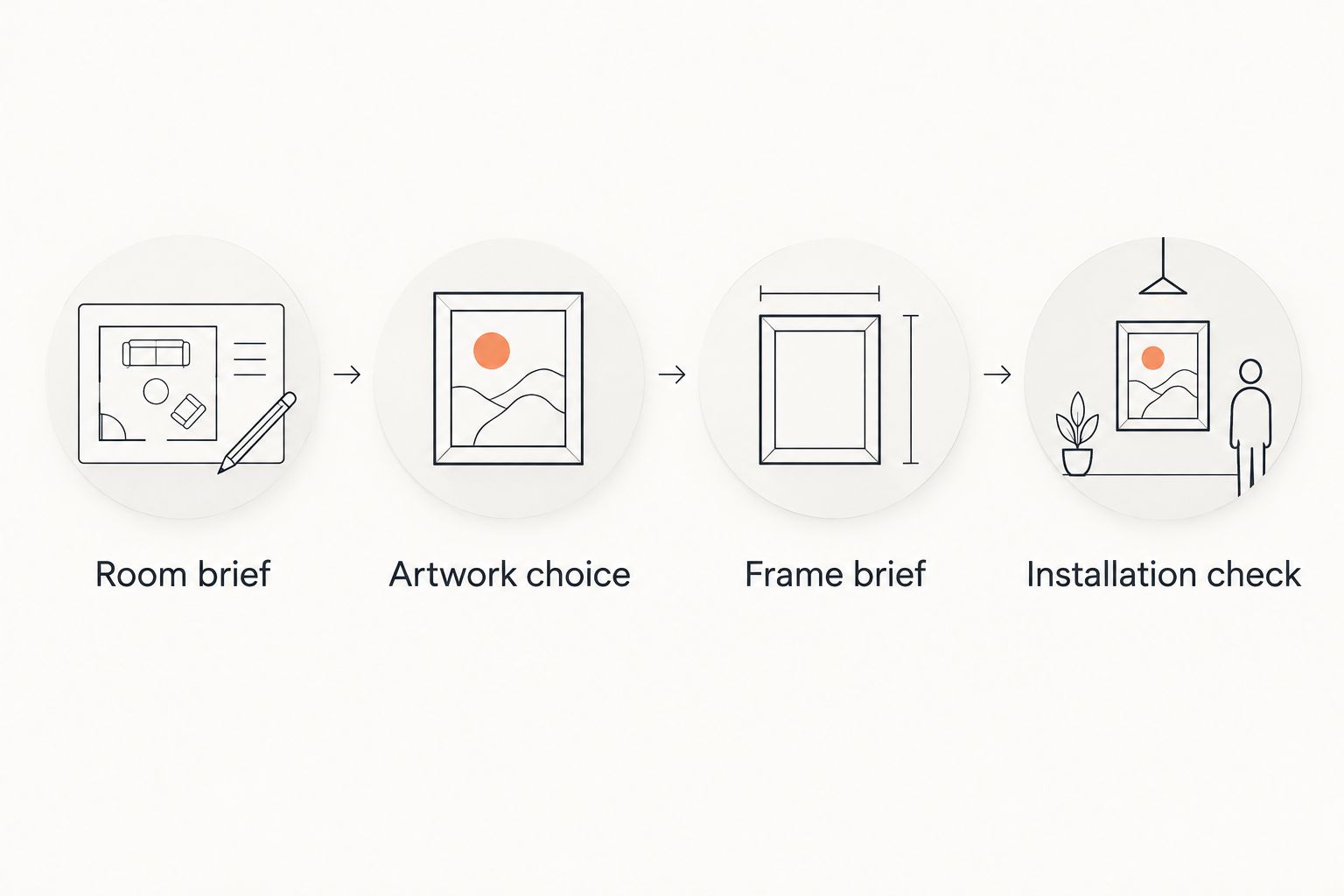
Keep the sequence consistent: Room brief, Artwork choice, Frame brief, then Installation check. Changing the frame's outer dimensions means repeating the template check, even if the print itself stays the same.
Installation configuration
Transfer the plan to the wall
- Inspect the finished piece and verify its outer dimensions against the approved brief. If they differ, remake the template before choosing fixing points.
- Identify the wall construction and the frame's hanging hardware. Use fixings suitable for that construction and the actual framed weight; follow the hardware manufacturer's instructions.
- Mark the arrangement with the template, then locate fixing points using the frame's real hardware. The top of the paper outline is not automatically the location of the hanger.
- Install and check the frame with a level. Keep fragile artwork away from the work area while drilling or fitting hardware.
- Recheck the display from the viewing positions used earlier. Photograph the completed wall and save the image with your project notes.
Expected result: The framed artwork occupies the footprint you approved, and the completed room photograph becomes a reliable reference for later changes.
Stop if you cannot identify a suitable fixing method. A decorative layout plan is not a structural assessment. Ask a qualified installer when the wall, frame weight, or mounting system requires expertise you do not have.
Refresh the shortlist when your board changes
A second workflow applies when you save new ideas after choosing the artwork. For a 2026 room refresh, use a review checkpoint rather than reopening every settled decision whenever a new Pin appears.
- Save the new reference to the relevant board.
- Identify what changed: subject, palette, framing, or arrangement.
- Compare that change against the written room brief.
- Update only the affected decision. A framing reference does not automatically require a different print.
- Repeat the footprint check if the proposed outer dimensions change.
This is a manual review workflow, not an automatic ordering or printing connection. Its advantage is control: you retain the original artwork source and approved measurements. Its limitation is that you must update the project note yourself.
Troubleshooting
The Pin does not lead to the original artwork
Use the Pin's destination to look for the artist or seller. If the source remains unclear, remove it from the purchasable shortlist and retain it only as a style reference. Do not print a saved image simply because you can download it.
The print fits, but the frame does not
Replace the print-size template with one matching the proposed finished outer dimensions. Ask the framer to confirm those dimensions before work begins. Mats and frame profiles change the footprint.
The artwork looks different from the screen
Check the display beside the actual wall and furnishings rather than relying on a phone image. For framing, use physical samples when possible. Do not treat screen colors as a guarantee of the finished appearance.
The arrangement works close up but fails from the doorway
Return to the entrance viewing position and review the entire wall, including furniture and adjacent openings. Move the paper template before moving hardware. A close-up view hides relationships that matter across the room.
The shortlist keeps growing
Return to the room brief and compare only the selected candidate images. Move unrelated inspiration out of the active decision. More saved references are not a reason to postpone choosing a subject indefinitely.
Customize your workflow
Extend the same process to another wall only after recording the completed arrangement. Keep separate notes for each location, particularly when the rooms have different furniture, lighting, or viewing distances.
For a grouping, template the whole arrangement as well as each frame. Record the gaps you choose so you can reproduce the layout during installation. Consistency comes from a documented plan, not from assuming every frame will occupy the same space.
Barksdale Fine Art's photography and digital art categories give you subjects to explore, but each room still needs its own brief. Keep a mountain landscape because it serves that room—not because a different room's board made it look appealing.
FAQ
How do I turn a Pinterest board into wall art?
Use the board to identify your preferred subjects and framing, then choose artwork from its original source. Measure the finished framed footprint, test a wall template, and install with suitable hardware.
Can I print a picture I saved on Pinterest?
Saving a picture on Pinterest does not give you reproduction rights. Use artwork you own, have permission to reproduce, or obtain through an authorized source.
Does this workflow automatically order framed artwork?
No, this workflow organizes a manual selection, framing, and installation process. You make the purchase and confirm framing details separately.
Should I choose the frame or the artwork first?
Choose the artwork first, then confirm its framed footprint. Use the room's existing finishes to guide the framing brief without letting the frame dictate an unsuitable subject.
How do I know whether the frame will fit my wall?
Make a paper template using the finished frame's outer dimensions. Check it against nearby furniture, openings, and your normal viewing positions before installing hardware.
Is Barksdale Fine Art suitable for a nature-inspired room board?
Barksdale Fine Art sells nature and landscape photography prints that suit a nature-focused shortlist. Confirm each selected work's dimensions and framing details before making the wall plan.
What should I do when my Pinterest board changes?
Compare each new reference with your written room brief before changing the artwork. Repeat the template check whenever the proposed framed dimensions change.
One last thing
Save a photograph of the completed wall, not just the inspiration that preceded it. That image records your actual furniture, frame placement, and room proportions. When you revisit the project, start from the room you have—not the room someone else photographed.